2026/07/26
Comic vs Manga vs Manhwa: A Practical Comparison
Compare comic vs manga vs manhwa by publishing tradition, reading direction, color, layout, serialization, workflow, and the format your story needs most.
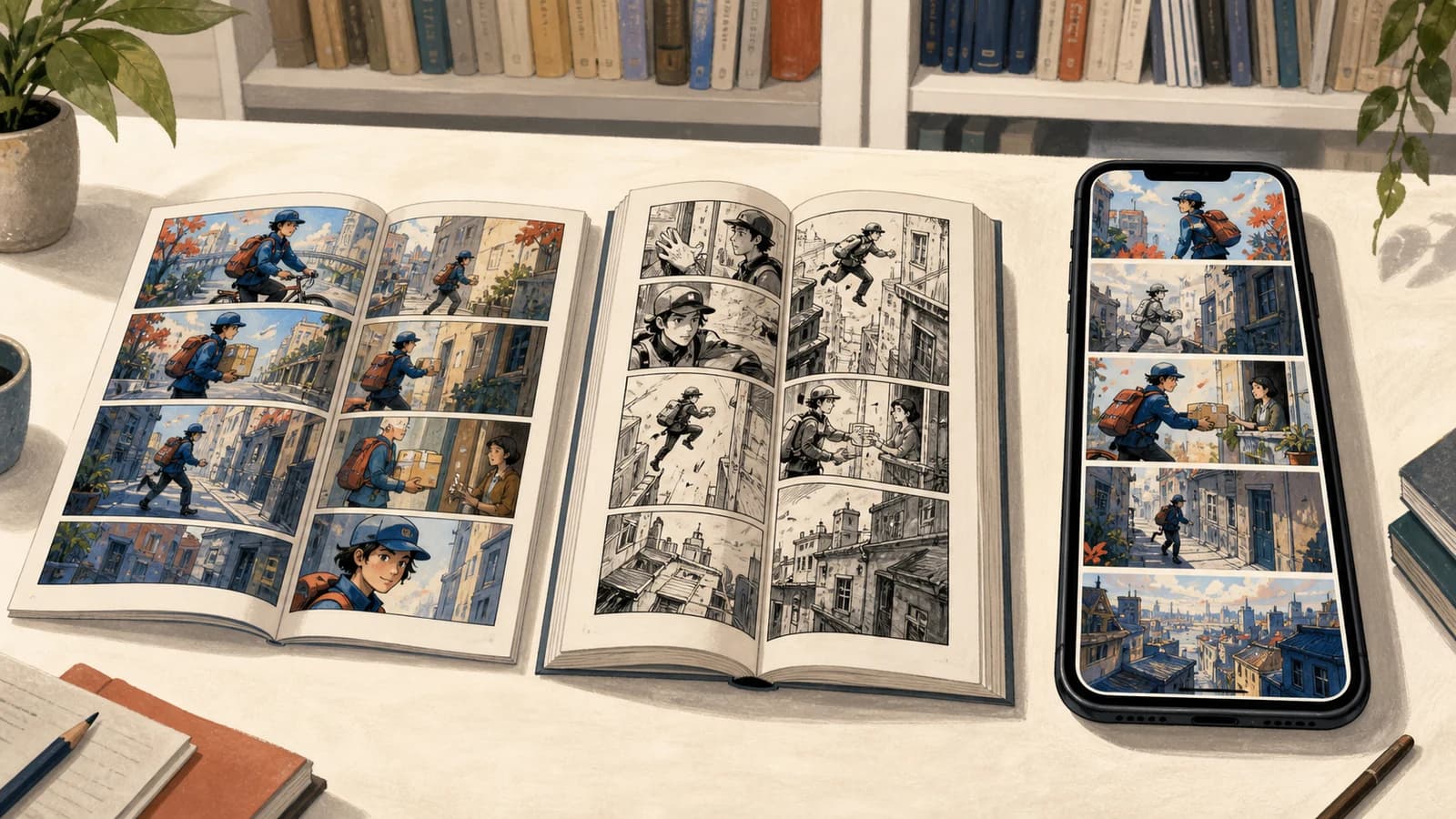
Comic, manga, and manhwa are overlapping comics traditions, not three rigid drawing styles. In English-language publishing, “comics” is the broadest term. “Manga” usually identifies comics made for or shaped by Japanese publishing contexts, while “manhwa” identifies Korean comics and, in current global usage, is often associated with Korea’s digital webtoon ecosystem. Origin, publisher, language, reading direction, page or screen format, and release channel tell you more than eye shape or coloring.
This guide is for readers comparing the terms and creators deciding how to build a project. It covers common patterns without turning them into rules. A Japanese manga can be full color; a Korean manhwa can be a printed black-and-white book; an English-language comic can use vertical scroll; and creators everywhere borrow techniques from one another.
Quick answer: choose a format from the intended reading experience and distribution plan. Use page-based left-to-right layouts for many English-language comic markets, page-based right-to-left layouts when working within a Japanese manga publishing convention, and vertical phone-first episodes when targeting a webtoon-style platform. Confirm the actual publisher’s specifications before drawing finished pages.
Comic vs manga vs manhwa at a glance
| Question | Comics in many English-language markets | Manga in Japanese publishing contexts | Manhwa in Korean publishing contexts |
|---|---|---|---|
| What the word means | broad medium and publishing category | Japanese word for comics; globally used as a market/tradition label | Korean word for comics; globally used as a market/tradition label |
| Common reading direction | left to right | right to left for many Japanese page editions | left to right for many Korean page editions; top to bottom for webtoons |
| Common delivery | periodical issue, graphic novel, newspaper strip, digital page or webcomic | magazine serialization, collected paperback volume, digital chapter | print volume, digital page comic, or vertically scrolling webtoon episode |
| Common color practice | full color is common in some commercial segments, but monochrome and limited color also exist | black and white is common for interior pages; color pages and full-color works exist | full color is common in webtoon production; print and older works vary |
| Layout unit | page, spread, strip, screen, or scroll | page and spread are central in print-oriented work | screen-width scroll segment is central in many webtoons; page layouts also exist |
| Production pressure | issue/page schedule, print costs, team workflow, retailer or platform needs | serialization deadlines, page count, monochrome reproduction, collected volume | episode cadence, long-scroll workload, color pipeline, platform upload rules |
| What it does not prove | a superhero genre or one art style | large eyes, speed lines, or black-and-white alone | color, romance, or vertical layout alone |
These are tendencies, not identity tests. The Library of Congress’s cataloging discussion makes an important point: manga, manhwa, and comics are not cleanly separate media. Its subject-heading decision treats the terms as words for comics while acknowledging that reading direction is a visible publishing distinction. That is a better starting point than a checklist of facial features.
Start with publishing tradition, not appearance
“Comic” names the medium: images arranged in sequence, usually combined with words, to communicate a story or idea. In everyday English it can also refer to a specific market tradition—such as a stapled monthly issue, a newspaper strip, or a graphic novel—but none of those formats owns the word.
“Manga” is the Japanese word used for comics. Outside Japan, booksellers, publishers, libraries, and readers use it more narrowly to identify Japanese comics and works positioned within the Japanese manga tradition. “Manhwa” is the corresponding Korean term. Outside Korea, it often signals a Korean work or a work distributed through Korean-origin digital comics systems.
This distinction matters because visual influence travels faster than publishing categories. An artist in Brazil can draw expressive black-and-white pages that borrow manga grammar without the work becoming a Japanese publication. A Japanese creator can make a left-to-right webcomic in color. A Korean studio can publish a bound page edition. Calling any black-and-white comic “manga” or any vertical color comic “manhwa” erases the production and market context behind the terms.
For cataloging, pitching, or metadata, ask concrete questions:
- Where was the work first published?
- Which publisher or platform commissioned or distributed it?
- What language and reading direction did the first edition use?
- Was it designed as pages, strips, or a continuous scroll?
- How does the creator or rights holder describe it?
When those answers conflict, use precise phrasing instead of forcing one box: “an English-language vertical-scroll webcomic influenced by manga,” or “a Korean print manhwa later adapted for webtoon release.”
Reading direction changes storytelling
Reading direction is not a decorative setting applied after the art. It affects the order of panels, balloon placement, character entrances, action vectors, page turns, and where a reveal lands.
Many English-language comics: left to right
Page-based comics published for English readers generally move from the upper left across and then down. Dialogue balloons follow that expectation. A character moving right can feel as though they are advancing with the reading flow; a figure looking left can pull attention backward. These are compositional tendencies, not moral meanings.
Many Japanese manga editions: right to left
VIZ Media’s official FAQ tells English-language readers to start Japanese manga from what may look like the “back” of a Western book and read right to left. Kodansha’s support material likewise identifies right-to-left direction as a common difference. Publishers retain that direction because mirroring pages can reverse handedness, signage, costume details, and the artist’s intended action flow.
If you plan right-to-left pages, build them that way from thumbnails. Put the first balloon on the right, design the eye path toward the left, and check facing-page reveals in the correct binding order. Do not finish a left-to-right comic and flip every page at export.
Webtoon-style manhwa: top to bottom
Many internationally distributed Korean manhwa arrive as webtoons: full-width image segments read by scrolling down a phone. Here the distance between images becomes timing. A short gap keeps conversation moving; a long gap can delay a reveal, imply silence, or create a change of location. The reader sees only part of the episode at once, so page-spread composition no longer works in the same way.
WEBTOON Entertainment describes its signature format as mobile vertical scroll and reports that the service was founded in Korea in 2005. Its later adaptations of existing page manga into full-color vertical editions are useful evidence that content origin and delivery format are separate decisions: a manga can be reformatted for vertical scroll without becoming Korean in origin.
Color is a production choice, not a passport
The familiar pattern is easy to recognize: many U.S. superhero issues are printed in color, many Japanese collected manga volumes use black-and-white interiors, and many webtoons are released in full color. The mistake is turning that pattern into a definition.
Color depends on economics, schedule, reproduction, team size, genre expectation, and platform. Kodansha describes manga as primarily black and white, not exclusively so. Weekly or monthly monochrome serialization can support a faster drawing and printing pipeline, while occasional opening pages or special editions may use color. Ink weight, screen tone, negative space, and line texture then carry distinctions that color might otherwise handle.
Many commercial color comics divide work among penciling, inks, colors, lettering, and editing, though solo and small-team projects are common. Full color affects every stage: palette continuity, lighting, flattening, rendering, prepress, and print cost.
Vertical webtoon teams often treat color as part of mobile recognition and atmosphere. Reusable 3D backgrounds, color keys, assistants, and asset libraries can help meet an episode schedule. That does not mean every Korean comic is colored or every vertical comic needs elaborate rendering. A restrained palette can be more sustainable and easier to read on a phone.
Before choosing color, make a production estimate:
- number of finished panels per episode or chapter;
- average backgrounds per panel;
- number of recurring characters and costume states;
- hours available between releases;
- whether an assistant or colorist is part of the plan;
- print requirements, if any;
- time for lettering, QA, localization, and export.
Color that cannot be maintained through episode four is not a useful promise to readers.
Page, spread, strip, and scroll create different pacing
A page gives the reader a bounded field. Even when panel order is clear, the reader can glimpse the page’s shapes and contrast before reading each moment. A spread adds the center fold and allows a wide reveal, but only when the platform or binding displays two pages together.
A manga page uses the same physical facts, with its reading direction reversed in many editions. Page turns are powerful because the next image can remain fully hidden. Tankōbon-style collected volumes also turn serialized chapters into a longer reading session, which may expose repeated recaps or cliffhangers differently than the original release.
A comic strip compresses the unit further. Three or four panels often carry one setup, turn, and payoff. If that is your actual scope, use the comic strip maker rather than treating a strip as a miniature manga chapter.
A vertical scroll replaces page turns with viewport reveals. The creator can control when an image first enters the screen, but device size and scroll speed vary. Large empty gaps are not automatically cinematic. They cost reading time and export length, and repeated gaps can flatten the rhythm they were meant to emphasize.
When converting between formats, expect recomposition rather than cropping:
- page balloons may need to move because a vertical reader sees fewer at once;
- wide establishing panels may need stacking or a new camera angle;
- a page-turn reveal may require scroll distance;
- vertical close-ups may become cramped in a print grid;
- dialogue written for one screen may crowd a small translated print panel;
- sound effects and directional motion may need redrawing.
WEBTOON’s 2025 announcement that a Japanese manga would be released in full color and reformatted for vertical scroll explicitly describes both changes. That wording is a useful production warning: adaptation involves more than slicing a page into strips.
Serialization shapes the work readers see
Format and release rhythm influence story structure.
In periodical comics, an issue may need an opening that orients readers, a middle escalation, and an ending that supports the next issue while still feeling substantial. Collected graphic novels may be released as one complete object or assembled from installments. Credits can reflect a specialized team.
Japanese manga is often serialized by chapter in magazines or apps before collection into volumes. Page limits and deadlines affect scene length, recap placement, chapter hooks, and how much rendering is practical. Demographic labels such as shōnen or shōjo describe editorial readership categories, not a reader’s gender restriction and not one genre or drawing style.
Korean webtoon serialization commonly presents episodes on digital platforms and organizes discovery around series pages, thumbnails, genres, and release days. WEBTOON’s current CANVAS documentation requires both square and vertical series thumbnails and a separate episode thumbnail. Those discovery assets are not panels from the story by default; they are part of publishing the series.
The Korea Creative Content Agency’s webtoon industry white paper treats webtoons as an industry with production, distribution, platforms, creators, and cross-media intellectual property. That industrial context explains why “manhwa” cannot be reduced to pastel color or a romance plot. Action, horror, comedy, nonfiction, and experimental work all exist within the market.
Which format should you choose for your project?
Do not choose a national label because you like a brush preset. Choose a delivery format, then describe your influences honestly.
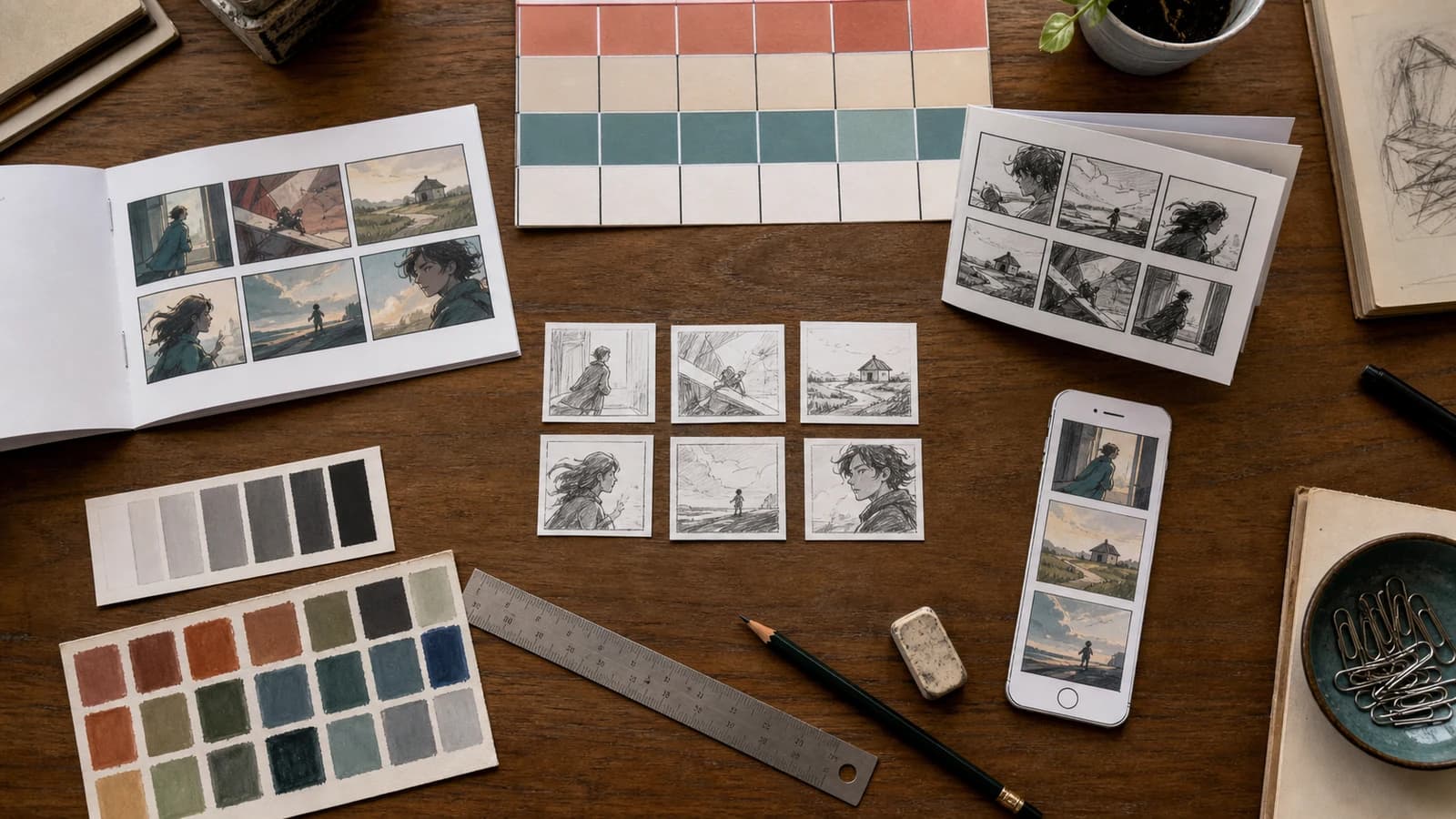
Choose a page-based left-to-right comic when…
- your primary readers expect English-language page order;
- print issues, graphic novels, PDFs, or page readers are the main destination;
- page turns and spreads are important to the story;
- your printer or publisher provides page, bleed, and color specifications;
- you can support the chosen color and team workflow.
For early page concepts, the AI comic generator can produce one square 1024×1024 raster composition from a prompt. It cannot manage an issue, return editable panels, preserve a trained character across pages, or produce final reliable lettering.
Choose a page-based right-to-left manga workflow when…
- the project is intended for a publisher, audience, or platform using that convention;
- you will thumbnail, stage action, and place balloons right to left from the beginning;
- monochrome reproduction supports the schedule and destination, if applicable;
- you understand the target submission and collection format.
The AI manga generator can help explore a black-and-white manga page concept. Treat the result as a visual draft. It does not create a serialized chapter, editable tone layers, correct Japanese text, or guaranteed character continuity.
Choose a vertical webtoon workflow when…
- the phone is the primary reading device;
- episode-by-episode digital release is part of the plan;
- you want to pace reveals with scroll distance;
- your production team can sustain the planned color and episode length;
- you have checked the current upload, thumbnail, content, and rights rules of the destination.
The AI manhwa generator can draft one 1024×1024 manhwa-style visual concept. It does not output a long vertical episode, separate editable panels, a reusable character model, or final dialogue. Plan the scroll in thumbnails and assemble approved assets in an editor.
Choose a hybrid description when that is more accurate
You might make a French-language black-and-white comic with right-to-left pages, or an Indonesian vertical webcomic influenced by Korean thrillers. The useful description names the object and context: “vertical-scroll fantasy webcomic,” “right-to-left original English-language comic,” or “print graphic novel with manga-influenced pacing.” Clear metadata helps readers more than an argument over whether the line art looks sufficiently manga-like.
A seven-question decision process
- Where will the first complete version be published? Name the platform, printer, publisher, or file type.
- What is the default reading direction there? Left to right, right to left, or top to bottom.
- What does the reader see at once? A spread, one page, a short strip, or one phone viewport.
- What is the release unit? Complete book, issue, chapter, or episode.
- Can the team sustain the visual plan? Count panels, backgrounds, characters, lettering, color, and revisions.
- Will the work be localized? Leave editable text and enough balloon or screen space for expansion.
- How will you describe it? Use origin, format, and influence without claiming a market identity the project does not have.
Write those answers at the top of the brief. They are more useful than a mood board containing unrelated covers.
Common comparison mistakes
“Comics means superheroes”
Superheroes are one influential genre and publishing sector, not the definition of comics. Memoir, journalism, humor, horror, romance, education, literary fiction, and experimental sequential art all use the medium.
“Manga means big eyes and black-and-white art”
No single face construction defines manga, and black-and-white is a common production pattern rather than proof of origin. Japanese manga covers a wide range of drawing systems, readerships, genres, and publishing models.
“Manhwa means a full-color romance webtoon”
That description matches a visible portion of the global market, not the whole Korean comics tradition. Printed manhwa predates mobile webtoons, and digital Korean platforms carry many genres. “Webtoon” is also used internationally for vertical-scroll webcomics made outside Korea.
“You can convert formats by changing the canvas size”
Canvas size is the easy part. Reading direction, reveal timing, panel hierarchy, balloon order, translation space, crop behavior, thumbnail discovery, and delivery rules all need another pass.
Preproduction checklist
- The project description names origin, delivery format, and influences precisely.
- Reading direction is fixed before thumbnails.
- Page, spread, strip, or viewport is the real composition unit.
- Color scope matches the team and release schedule.
- The release unit—issue, chapter, volume, or episode—is defined.
- Dialogue remains editable for proofreading and localization.
- Thumbnail and cover assets are planned separately from story panels.
- The destination’s current dimensions, file limits, content rules, and rights terms are recorded.
- A conversion to another format is budgeted as recomposition, not simple cropping.
- AI-generated drafts are reviewed for anatomy, continuity, text errors, references, and publication rights.
Frequently asked questions
What is the main difference between comics, manga, and manhwa?
The clearest difference is publishing and cultural context, not one drawing style. Comics is the broad medium; manga commonly identifies Japanese comics and publishing traditions; manhwa commonly identifies Korean comics. Reading direction, page or scroll format, color practice, and serialization often differ, but each category contains exceptions.
Is manga always read right to left?
Many Japanese print manga and their licensed translations retain right-to-left page order, but “always” is too strong. Digital experiments, localized adaptations, educational works, and comics created outside Japan may use other directions. Follow the specific edition or publisher, and design the original project in its intended direction.
Is manhwa the same as webtoon?
No. Manhwa means Korean comics broadly. Webtoon refers to a digital comics ecosystem and, in common usage, a vertical-scroll format strongly associated with Korea. Many globally known manhwa are webtoons, but Korean print manhwa also exists, and creators outside Korea publish vertical webtoons.
Are comics always in color while manga is black and white?
No. Full color is common in parts of English-language commercial comics and webtoon publishing, while black-and-white interiors are common in Japanese manga. All three traditions include monochrome, limited-color, and full-color work. Budget, schedule, reproduction, platform, and artistic choice determine the practical answer.
Can I call my work manga or manhwa if I live elsewhere?
Usage varies among creators, readers, publishers, and markets. For a pitch, library record, or store listing, a precise description usually works better: name the language, page or scroll format, reading direction, and influence. Let the publisher or platform determine any formal category used for submission and discovery.
Which Anime Maker tool should I start with?
Start with the output structure, not the label. Use the AI comic generator for a compact page concept, the AI manga generator for a black-and-white manga page direction, the AI manhwa generator for a manhwa-style visual concept, or the comic strip maker for a 3–4 panel beat. Each produces one raster draft, not a finished publication.
Sources and further reading
- Library of Congress: Subject-heading discussion of manga and manhwa — terminology, synonymy, and the limits of treating style as a category.
- VIZ Media FAQ — publisher explanation of manga and right-to-left reading.
- Kodansha Support Center — publisher overview of manga reading direction, monochrome practice, and genre range.
- WEBTOON Entertainment: Global creative ecosystem — Korean origin, vertical-scroll format, serialization, and international platform development.
- WEBTOON CANVAS: Thumbnail sizes and publishing assets — current series and episode thumbnail requirements.
- Korea Creative Content Agency: 2023 Webtoon Industry White Paper — industry, distribution, platform, creator, and cross-media context.
- WEBTOON Entertainment: Manga reformatted for vertical scroll — a documented example of full-color vertical reformatting.
The useful question is not “Which look am I allowed to copy?” It is “What reading experience, production system, and publishing context does this story need?” Answer that first. Then borrow techniques with care, describe the work accurately, and build the pages or scroll for the reader who will actually encounter it.
Author

Categories
Comic vs manga vs manhwa at a glanceStart with publishing tradition, not appearanceReading direction changes storytellingMany English-language comics: left to rightMany Japanese manga editions: right to leftWebtoon-style manhwa: top to bottomColor is a production choice, not a passportPage, spread, strip, and scroll create different pacingSerialization shapes the work readers seeWhich format should you choose for your project?Choose a page-based left-to-right comic when…Choose a page-based right-to-left manga workflow when…Choose a vertical webtoon workflow when…Choose a hybrid description when that is more accurateA seven-question decision processCommon comparison mistakes“Comics means superheroes”“Manga means big eyes and black-and-white art”“Manhwa means a full-color romance webtoon”“You can convert formats by changing the canvas size”Preproduction checklistFrequently asked questionsWhat is the main difference between comics, manga, and manhwa?Is manga always read right to left?Is manhwa the same as webtoon?Are comics always in color while manga is black and white?Can I call my work manga or manhwa if I live elsewhere?Which Anime Maker tool should I start with?Sources and further reading
More Posts
Production guides
Anime Camera Angles: A Practical Storytelling Guide
Plan anime camera angles that clarify story, emotion, and screen direction. Compare shot sizes, build a shot list, and write prompts you can test.
Production guides
Comic Panel Layout Guide: Control Flow and Pacing
Use this comic panel layout guide to plan readable grids, gutters, focal panels, dialogue space, page turns, and mobile-friendly story flow for print or phone.
Production guides
Types of Manga Speech Bubbles: A Practical Guide
Learn the main types of manga speech bubbles, what each shape implies, and how to place, letter, translate, and check them without confusing readers.
Newsletter
Join the community
Subscribe to our newsletter for the latest news and updates