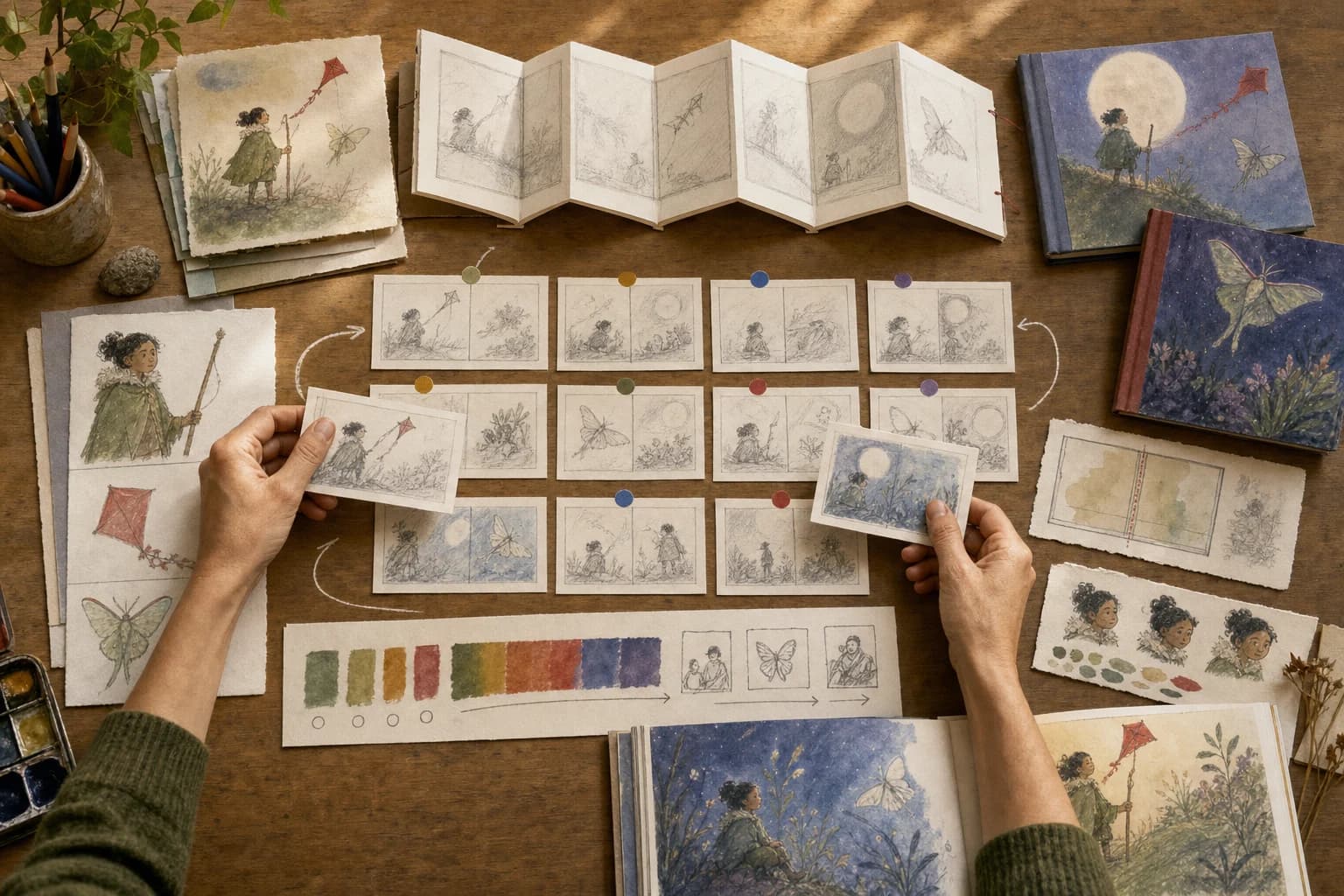
Move approved illustration directions into a layered production file at the required trim, bleed, resolution, and color settings. Keep art, masks, text, credits, and guides editable. Use licensed fonts with the needed language and accessibility support. Confirm whether the destination is offset or digital print, fixed-layout ebook, reflowable ebook, web reader, classroom slide, or another format; each has different constraints.
Proof the real medium. Print and bind a copy to inspect gutter loss, trim, color shifts, dark detail, paper show-through, text size, line breaks, and page-turn timing. On screens, test common sizes, orientation, zoom, contrast, navigation, and alternative text. For read-aloud or audio editions, review pronunciation, pacing, speaker labels, sound balance, and synchronization rather than assuming the printed layout transfers automatically.
Keep provenance and permissions: manuscript versions, prompts, generated concepts, source references, model and property releases when applicable, licenses, fonts, edit history, approvals, accessibility copy, printer specifications, proofs, and final exports. Check accidental logos, recognizable people, protected characters, cultural property, privacy, and contractual restrictions. A careful record supports collaboration and revision even though it cannot settle every legal question.