
01
State the drawable conflict
Name the protagonist, concrete goal, visible resistance and costly climax choice before choosing page count.
Comic script generator
Turn your own premise into a practical comic script scaffold with page purposes, panel suggestions, visual direction, dialogue intent, page-turn jobs and revision checks. The planner uses transparent deterministic templates in this browser, not a hidden text model, and exports an editable plan rather than pretending to write a finished comic for you.
Enter the premise, protagonist and costly choice, then choose the page count and production direction. Every output remains editable, copyable and downloadable in the same tab.
This deterministic planner runs in your browser. It does not send your premise to a text-generation service.
The output is a development scaffold, not a finished screenplay, drawing, lettered page or publication clearance.
The output is a development scaffold, not a finished screenplay, drawing, lettered page or publication clearance.
comic script generator
The result shows page purposes, panel suggestions and editorial checks produced from visible rules. It is useful because you can challenge and rewrite it—not because it claims authorship.
Actual output
A page-and-panel planning document in Markdown or plain text.
Generation method
Deterministic local templates shaped by your inputs; no text model or account is involved.
Author responsibility
You write the story, dialogue and final visual decisions, then verify rights, continuity and cultural detail.
Script foundations
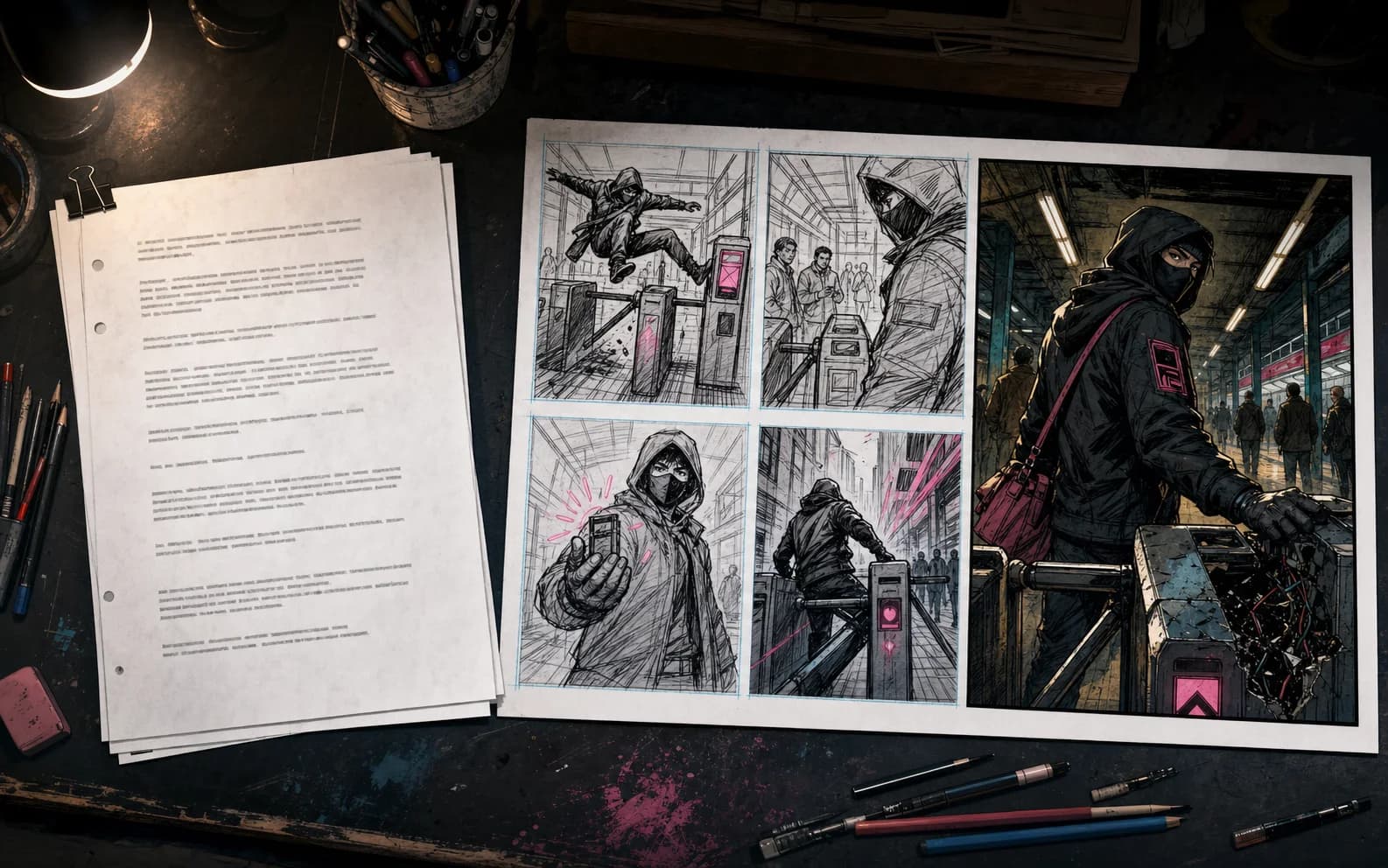
A comic premise needs more than a setting and mood. Name the protagonist, the concrete result they pursue, the visible force blocking them and the cost of success or failure. “A mechanic discovers a hidden station” opens a door; “a mechanic must reopen it before the last train while each repair erases a commuter’s memory” creates actions, evidence and a clock. The planner asks for these elements separately because a page can stage a repair, a disappearing photograph or a missed train more clearly than it can stage an abstract theme.
Keep the premise short enough to guide decisions but specific enough to reject weak scenes. A useful test is to circle the nouns that can appear on the page and underline the verbs an artist can draw. If the statement contains only feelings, history and world lore, add a present-tense task. If it contains only spectacle, add the relationship or value that makes the choice matter. The final comic may be subtle; the production brief still needs operational clarity.
The browser planner does not expand your idea through a language model. It distributes your own premise across editorial beat templates and combines them with page, panel and revision prompts. That makes the method limited but inspectable. Treat every generated line as a question: what exactly happens in this story, who performs it, where is the evidence and what state changes? Replace template language before giving the document to an artist or editor.
Page architecture
A page can contain several actions, but it should have one dominant reason to exist. It may establish geography, deliver evidence, force a decision, change a relationship, stage a reversal or let a consequence land. When adjacent pages perform the same job, combine them or change what the second page adds. Page count is a production constraint, not a target to pad. The planner maps a sequence of beat purposes across the length you choose, but you decide which beats deserve expansion or compression.
Thumbnail page blocks before polishing individual panels. Mark dialogue-heavy pages, silent action, reveals, location changes and emotional peaks. A uniform grid may be appropriate for calm testimony; a varied page may better support collision or discovery. Do not vary panel count mechanically. Increase density to show accumulation or competing information, and reduce it when a gesture, environment or consequence needs duration. View facing pages together because their dark shapes, figures and balloons interact before the reader isolates one panel.
Page one and the final page carry extra weight. The opening teaches the reader how to move through the world and what visual details matter. The closing should show a materially altered action, place, prop or relationship rather than explain the theme in a caption. Between them, track which strategy the protagonist uses and why it stops working. Structure becomes visible when a new act changes available choices, not when a heading announces that the story has entered act two.
Panel direction
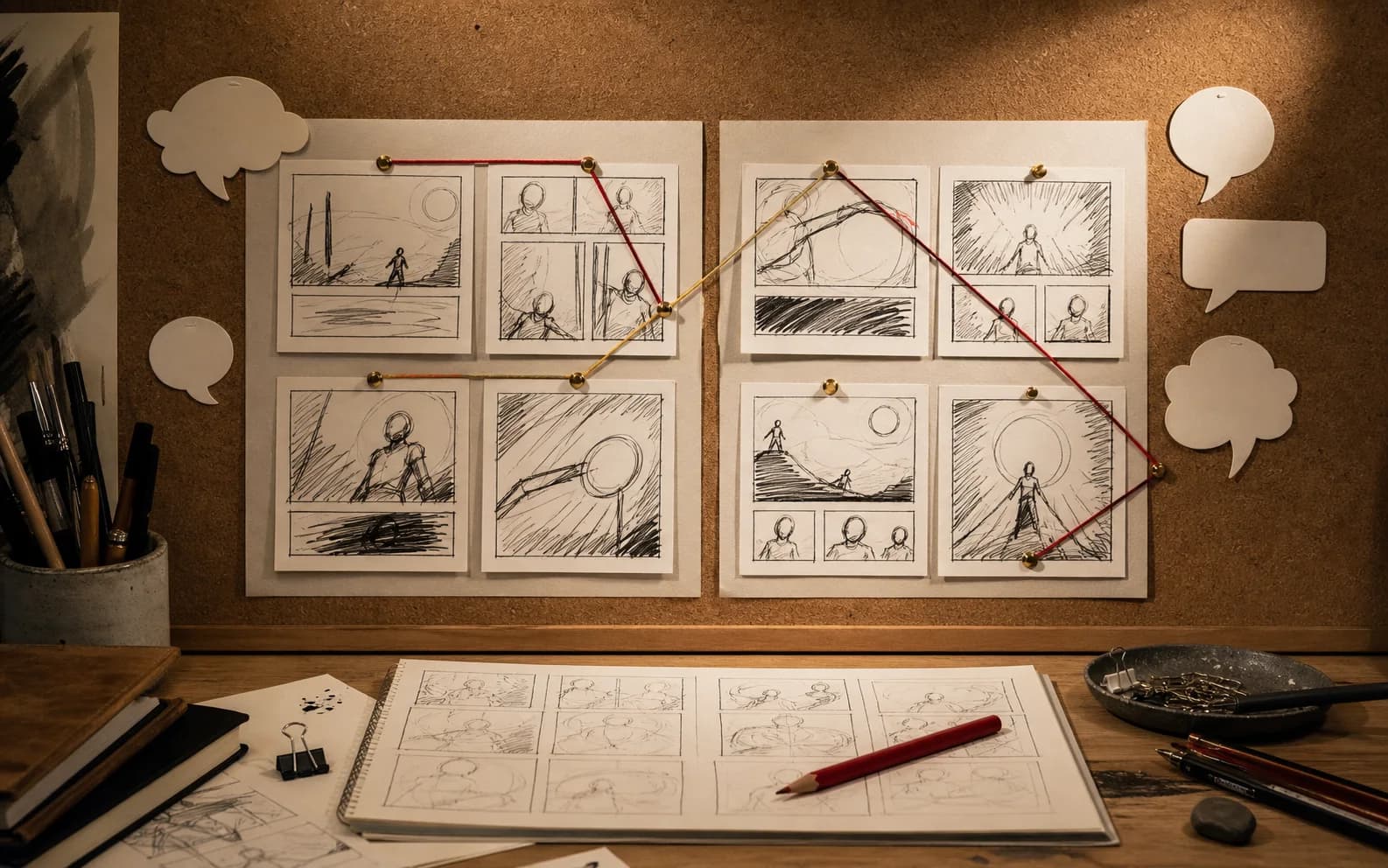
A panel description should identify the story event, essential spatial facts, visible emotion and continuity requirements. State who acts, what changes and which object or relationship must remain legible. Avoid prescribing every camera choice unless the angle carries story information or the production specifically requires a locked board. “Low angle, dynamic shot, dramatic lighting” can sound decisive while leaving the artist unsure which hand holds the key or whether the witness sees the exchange.
Separate non-negotiable facts from opportunities. An artist may find a stronger crop, staging or reaction than the writer imagined. Mark a required insert when a later payoff depends on the serial number; otherwise describe the purpose and allow visual problem-solving. Include the location, time, character states and important props at the first panel of a scene. After that, mention only changes. This reduces repeated prose and makes continuity differences easier to spot.
Use shot size and viewpoint because relationships change. A wide panel establishes geography or isolation; a two-shot shows negotiation; a close detail supplies evidence; a reaction reveals a private cost. Cutting closer every panel does not automatically create intensity. Maintain screen direction, eyelines and body orientation across action. If disorientation is intentional, establish the normal geography first so the break reads as a choice rather than an error.
Dialogue and lettering
Comic dialogue shares the panel with acting, environment and the reader’s path through balloons. Give each speaker an immediate tactic—question, deflect, recruit, threaten, test, reassure or conceal—then remove lines that only describe visible action. A character voice is more than slang. Sentence length, specificity, formality, interruption, metaphor and what the person refuses to name all reveal role and pressure. Read the scene aloud without character names; if every line sounds interchangeable, revise the tactics and information asymmetry.
Estimate balloon room at thumbnail stage. Long text placed after final art forces small type, covers acting or creates a tail maze. Break a speech only when the pause changes emphasis or the listener’s reaction matters. Captions should carry time, place, necessary context or a distinct narrative consciousness—not duplicate the image. When a line is essential for comprehension, make sure reading order remains clear without relying on decorative tail crossings.
Lettering is part of composition. Note whispers, broadcasts, overlapping speech and off-panel voices by function, but leave final font, balloon and effect treatment to the letterer or shared style guide. Plan localization early: translated text can expand, reading conventions vary and jokes may require adaptation. Keep an editable script with speaker names and accessible dialogue text instead of treating words embedded in a flattened image as the only record.
Page turns and transitions
A page turn can ask a question, complete an action, reveal space, reverse an assumption or rhyme with an earlier image. It does not need a manufactured cliffhanger on every page. Choose what the reader knows before the turn and what changes immediately after it. If the reveal is already visible on the facing page, it is not withheld. Thumbnail recto and verso positions for print, and test scroll distance on a phone for digital release.
Panel transitions also control inference. Moment-to-moment changes slow a brief action; action-to-action jumps to the next meaningful phase; subject-to-subject cuts depend on clear shared context; scene-to-scene cuts need enough time or place evidence to orient the reader. Do not label the categories in the final script unless useful to collaborators. Use them to diagnose why a sequence feels sluggish, abrupt or confusing.
Build setup and payoff through visible repetition with change. A key first used to open a locker can later become evidence, leverage or a memorial. Match composition when the comparison matters, and alter one decisive element. The planner’s transition prompts are starting points; replace them with the exact question, motion, withheld fact or visual rhyme your pages use. A generic “dramatic reveal” is not a production instruction.
Continuity and collaboration
Maintain a scene ledger with time, location, weather, costume, injuries, carried objects, character knowledge and relationship status. Record when each fact changes. If page eight moves before page five, the ledger reveals which bandage, key, secret or alliance must move with it. Visual continuity is not only cosmetic: who knows a fact and who owns an object can determine whether the plot still makes sense.
Give collaborators versioned documents and explicit owners. The writer owns story intent and source accuracy; the artist solves visual staging; the letterer manages readable language; the editor checks the whole sequence. Those roles can belong to one person, but the checks remain distinct. Use comments for unresolved questions and close them deliberately instead of silently rewriting a shared file. Exported Markdown is convenient for version control, while plain text is useful for systems that should not preserve formatting marks.
Name files by project, sequence and revision rather than “final-final.” Keep script, thumbnails, pencils, inks, color, lettering and approvals connected through a production table. The local planner does not save an account project or recover a closed tab, so download a working document after generation. Its privacy advantage comes with that responsibility: browser state is temporary and belongs to the current device.
Revision order
Review from largest dependency to smallest. First ask whether the protagonist’s actions cause the climax and whether the outcome changes a visible state. Then inspect scene purpose, page rhythm, spatial clarity, performance, dialogue, continuity and finally wording. Polishing a caption on a page that may be cut wastes time and makes structural change emotionally harder. The generated checklist follows this dependency order, but an editor should adapt it to the project and audience.
Print thumbnails or view pages very small. You should still see focal hierarchy, quiet and dense passages, repeated compositions and page-turn emphasis. Then hide the words and test whether the action is understandable. Next read only the words and check whether they form a coherent but not redundant track. Finally combine them. Comics create meaning between channels; a drawing and caption that each work alone may still cancel or duplicate one another.
Invite a cold reader to mark confusion without first explaining the world. Ask what changed on each page, what the protagonist wants and what they expect after each turn. Do not defend the draft during the first pass. Sort findings into intentional uncertainty, missing evidence and simple clarity problems. Revise the smallest upstream cause that resolves several downstream notes, then repeat the test.
Rights and delivery
A script can be creatively original and still contain material that needs permission or review: real people, private information, trademarks, lyrics, quoted text, recognizable interiors or licensed characters. Record sources as you write. Mark placeholders rather than copying protected language into art. If the story addresses a specialized culture, profession, disability, historical event or trauma, budget time for appropriate research and sensitivity review rather than treating one search result as authority.
Specify deliverables before final art: page dimensions, bleed, safe area, color space, resolution, layer expectations, lettering files, accessibility text and naming conventions. A web episode, stapled mini-comic and offset book have different constraints. The planner exports content structure only. It does not impose printer spreads, create a PDF/X file, package fonts, separate colors or verify that an artist contract grants the intended use.
Keep human credit proportional to the work. A deterministic template does not become a co-author, and software should not erase the writer, artist, letterer, editor or consultant. Document tools when a client, platform or agreement requires it. Before publication, confirm the final sequence, facts, permissions, credits and accessible version against the approved script—not against memory of an earlier draft.
01
Name the protagonist, concrete goal, visible resistance and costly climax choice before choosing page count.
02
Use the local planner to distribute editorial purposes, then replace every generic line with your actions, props and locations.
03
Test panel order, focal hierarchy, balloon room and recto-verso reveals before detailed scripting.
04
Record required facts, performance and continuity; let the artist solve opportunities and remove dialogue that repeats the image.
05
Check causality, page purpose, geography, performance, words and continuity in that order.
06
Export the script, version it, attach references and rights notes, and confirm art, lettering, accessibility and print specifications.
The planner uses fixed local templates. Regeneration changes assignments, not authorship or factual understanding.
Dialogue prompts describe purpose and tactics; you must write voices, subtext, facts and final words.
Panel suggestions are production notes, not generated drawings, page layouts, balloons or font files.
The checklist reminds you what to track, but the browser does not understand your character or prop states.
Closing or reloading clears the working result. Download Markdown or plain text into your own versioned system.
Research, permissions, likeness, trademarks, contracts, credits and publication review remain human responsibilities.
Reviewed 2026-07-22 · Anime Maker product and editorial team
Page illustrations are editorial examples, not live account task logs. Judge the tool by the result shown in your own output panel.
No. It builds an editable page-and-panel scaffold from your inputs using fixed local templates. You write the actual actions, dialogue, voices and final directions.
No. The current planner is deterministic and runs in the browser. Regeneration rotates transparent editorial patterns; it does not send your premise to a language model.
Include the story event, essential geography, visible performance and continuity facts. Leave optional composition choices to the artist unless an angle or crop carries required information.
There is no universal number. Use density to control information and time, then check reading order and balloon space at thumbnail size. The tool varies patterns as prompts, not rules.
Yes. Copy the plan or download Markdown and genuine plain text. Both contain the project brief, page plan, notes and revision checklist.
No cloud project is created. The current state lives in this tab, so download or copy the plan before closing or reloading.
Use it as a starting structure, then replace generic prompts with exact actions, locations, props, character states and references. Discuss visual freedom and deliverables with the artist.
Fix causality and the climax choice first, then scene and page purpose, spatial clarity, performance, dialogue, continuity and final wording.