
01
Define story and audience
Write a drawable pursuit and cost, then identify the actual demographic, format, language and release context.
Manga script generator
Shape your own premise into a right-to-left manga planning document with page purposes, panel rhythm, ma, visual direction, dialogue intent, sound notes and revision checks. The planner runs transparent editorial rules in this browser and produces an editable scaffold for your own writing and drawing workflow.
Enter the premise, protagonist and costly choice, then choose length and tone. The page plan respects right-to-left reading and uses distinct quiet, acceleration, impact and aftermath beats.
This deterministic planner runs in your browser. It does not send your premise to a text-generation service.
The output is a pacing and page-direction scaffold. It is not finished manga, generated dialogue, artwork, lettering, translation or editorial approval.
The output is a pacing and page-direction scaffold. It is not finished manga, generated dialogue, artwork, lettering, translation or editorial approval.
manga script generator
The output exposes every template decision: beat, panel pattern, visual prompt, dialogue purpose, page-turn job and sound note. It never presents deterministic assembly as an authored finished manga.
Actual output
A right-to-left page and panel planning document in Markdown or plain text.
Generation method
Deterministic local templates shaped by your inputs; no text model or account is involved.
Author responsibility
You write the story, dialogue and final visual decisions, then verify rights, continuity and cultural detail.
Manga foundations
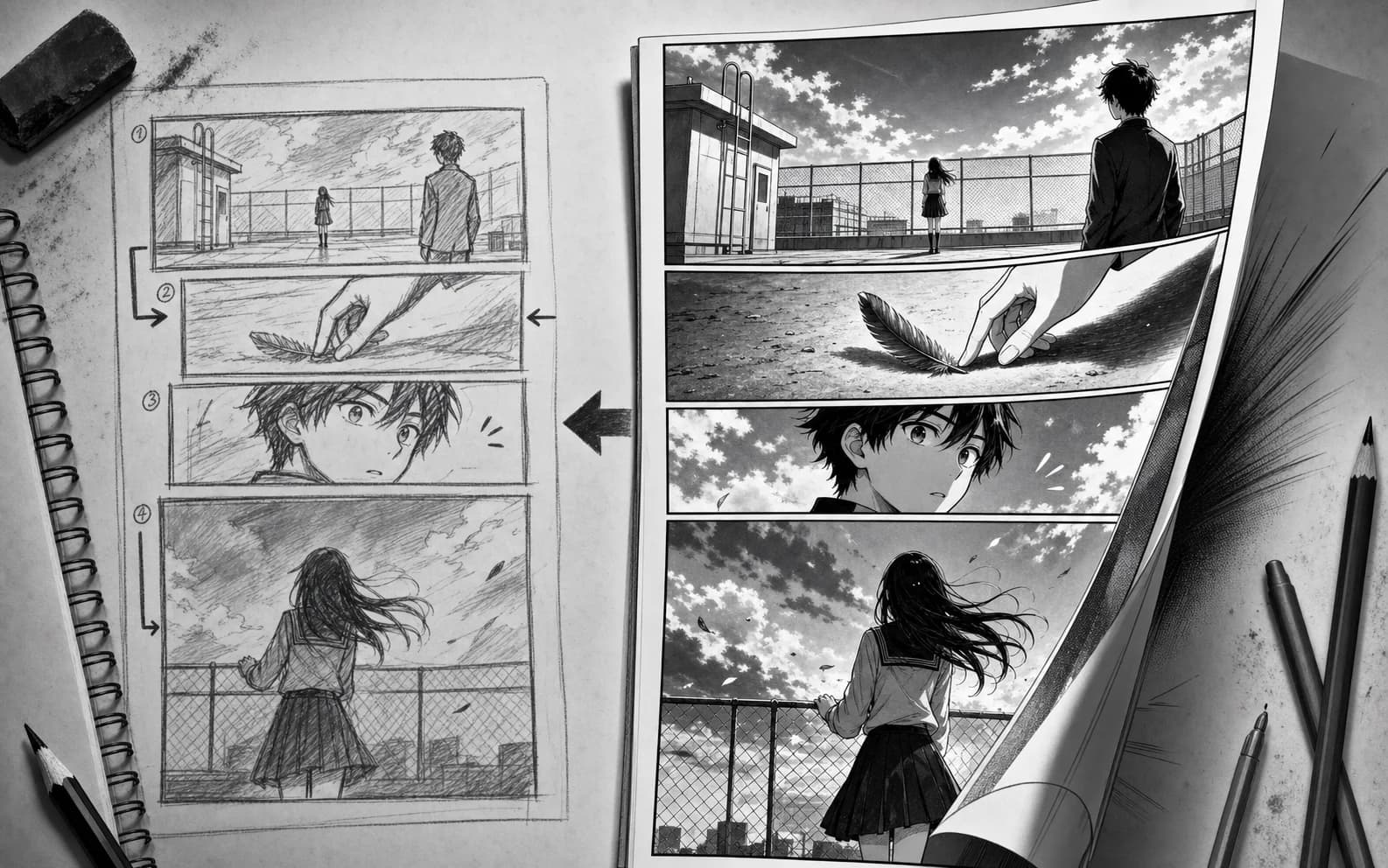
A workable manga premise names a person, a present-tense pursuit, resistance and a choice whose consequence can be drawn. Atmosphere matters, but it becomes productive when attached to an action: waiting at an empty platform, hiding a damaged charm, following footprints that vanish at sunrise. The planner asks for a protagonist and climax cost because those inputs help distribute decisions rather than merely distributing lore. Replace every template beat with the exact gesture, object, location and relationship in your story.
Do not treat “manga” as a genre or a bundle of decorative symbols. It describes a broad field of publishing, drawing and sequential storytelling practices with different demographics, histories and house conventions. Decide the actual readership, format, language, release cadence and cultural setting. A school uniform, honorific or shrine is not neutral texture; research the institution and social behavior if your story uses them. Originality comes from observed specificity and character choice, not from imitating a recognizable series.
This planner assembles your inputs with visible deterministic rules instead of a hidden text model. That keeps the premise in the current browser tab and makes regeneration predictable. The result is a development scaffold to rewrite, not a claim that software authored a culturally grounded manga script or solved narrative judgment for you.
Reading direction
Traditional Japanese manga pages are commonly read from the upper-right toward the lower-left, with page progression opposite many Western books. The eye still follows faces, movement, contrast, balloon placement and panel shape, so “right to left” is not solved by reversing a finished Western layout. Begin thumbnails in the intended direction. Check where a figure looks, where an action exits and which balloon a reader encounters first before refining the drawing.
Design facing pages and physical turns. In a right-bound book, the next page relationship differs from a left-bound edition, and localization may require mirroring, re-lettering or a separate layout. Confirm printer and publisher requirements rather than relying on a universal template. Mark recto, verso, spread and chapter-start positions in the production document. The planner supplies a right-to-left reminder and page beats, but it cannot know binding, trim, gutter or platform behavior.
Test thumbnails without dialogue. If the reading path fails, additional arrows or crowded balloons rarely fix the underlying staging. Use value, scale, gaze and overlap to lead the eye. Then add balloon shapes and tails as compositional masses. Preserve room for translations and accessible text. A page that only works in one font size or one language is fragile even when its first version looks elegant.
Ma and page rhythm
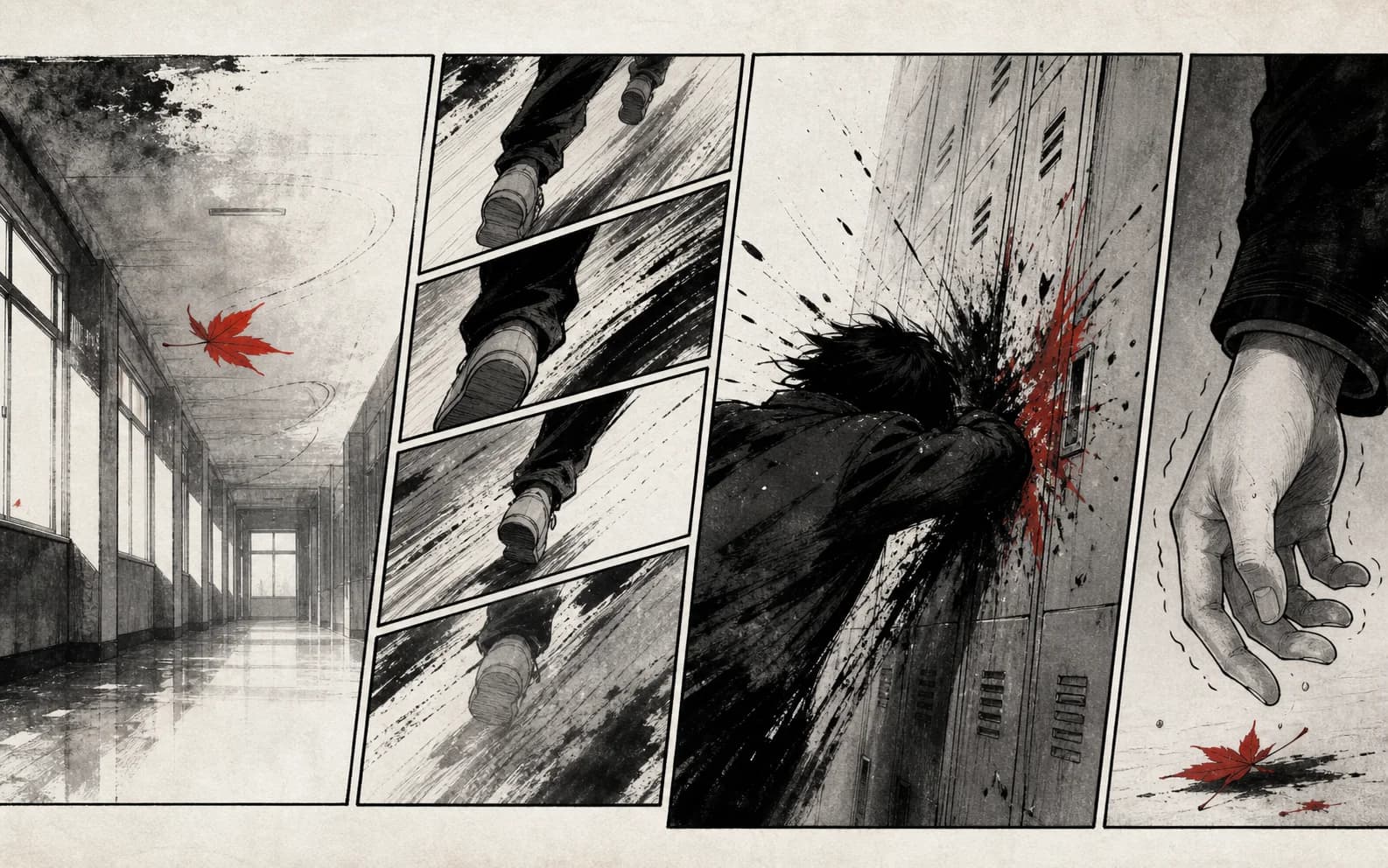
Ma is often translated as interval or negative space, but in a script it should be described through observable duration: a hand remains on a door, rain fills an empty gutter, a character looks past the speaker, footsteps stop off panel. The interval changes anticipation, intimacy or power. Blank panels added merely to appear “cinematic” do not create depth. State what the reader notices during the pause and why the next action feels different because of it.
Control subjective time through panel count, repetition, crop and gutter. Several small views of a breath can lengthen one second; a large panel can suspend an impact; a jump from preparation to aftermath can make action feel sudden. Alternate density intentionally. If every page uses the same number and size of panels, emotional peaks lose distinction. The generated patterns include quiet, acceleration, impact and afterimage, but the script must connect those rhythms to your character’s changing perception.
Environment can perform when characters are still. A classroom clock, train-door light, insect sound or moving curtain may carry time and pressure without an explanatory thought balloon. Choose recurring details and change their meaning across the chapter. Record the first use, variation and payoff so visual motifs support structure instead of becoming random decoration.
Panel performance
Manga performance often depends on precise fragments: fingers tightening around a strap, a face withheld until after a line, shoulders turning while the eyes remain, or a character occupying less of the shared frame. Script the visible behavior and its narrative function. Avoid prescribing generic emotion symbols when posture and timing can carry the scene. Stylized marks are strongest when anchored in a consistent visual language and appropriate tone.
Use close-ups because the reader needs a specific perception, not simply because the moment is emotional. A close hand can reveal decision, injury or deception; an eye can redirect attention; an object detail can transform earlier evidence. Balance close information with enough geography to know where bodies and exits are. During action, preserve right-to-left motion and re-establish space after extreme angles or impact fragments.
Internal monologue should add a perspective the image cannot provide. Remove lines that label the exact feeling already visible. A contradiction between thought, speech and behavior can create useful tension, but it must remain legible. Read the scene as images only, words only and then both tracks together. Revise when one channel merely repeats the other or when omission creates accidental confusion rather than purposeful uncertainty.
Page turns and reveals
A reveal works when the reader encounters it at the intended moment. In print, place the setup before the right-to-left physical page turn and the changed fact immediately after it. In vertical or app formats, the equivalent may be scroll distance, screen boundary or episode break. Test on the release medium. A reveal that appears in a thumbnail overview may still fail if production pagination moves it to a facing page.
The strongest turn is not always the largest surprise. It may complete a movement, expose a relationship, return to a changed object or give space to an emotional response. Write the pre-turn question and post-turn answer in plain language. If neither changes action or understanding, the turn is decorative. Avoid withholding basic geography solely to confuse; establish what the viewpoint character could reasonably perceive.
Use spreads selectively. A spread can create scale or suspended time, but critical details near the gutter may disappear in binding and digital viewers may split the image. Ask the printer or platform how spreads are handled. Keep dialogue reading order clear across both pages, and prepare an alternate single-page presentation when the release system cannot guarantee the intended view.
Sound and lettering
Before choosing a written sound effect, describe what makes the sound, its texture, distance, duration and story function. A metal locker slam, cloth rustle and cicada bed create different shapes and positions. Record whether characters hear the sound and whether it begins off panel. This gives the letterer or translator useful intent without pretending one romanized effect is universally correct.
Japanese sound symbolism has linguistic and cultural conventions that require real knowledge. Do not scatter copied kana as decoration. If the final manga uses Japanese, work with a fluent writer or letterer and verify nuance, register and typography. If it is released in another language, choose whether to translate, annotate, retain or redraw effects according to the audience and publisher. Preserve an editable source layer whenever possible.
Balloon flow must support right-to-left reading and performance. Keep tails unambiguous, avoid covering hands and expressions, and leave expansion room for localization. Use different treatments for speech, thought, device audio and narration only when the distinction remains accessible. Store dialogue and sound descriptions as text outside the flattened page so screen-reader, translation and revision workflows are possible.
Cultural and visual research
When a story uses a real place, institution, occupation, era, ceremony or social relationship, collect first-party references and consult people with relevant experience. Check schedules, room layouts, clothing rules, forms of address, transport, weather and everyday behavior. Specificity prevents a setting from becoming a collage of signs and props. Record sources beside the scene they support so later revisions can distinguish evidence from invention.
If the setting is fictional, define consistent material rules: architecture, transit, food, technology, school or work hierarchy, and how characters move through space. Visual design should serve action. A complex uniform needs version and seasonal notes; a recurring shrine gate or machine needs a location diagram and scale reference. Build a character and environment sheet before a long chapter so panel-to-panel continuity does not depend on memory.
Avoid directing the artwork to copy a living or recognizable artist. Describe observable decisions—brush weight, screentone density, spot blacks, edge control, background detail, comedic deformation, quiet negative space—then develop an original system appropriate to the story. Keep inspiration references broad and document what the project changes. Style does not compensate for weak causality, unreadable flow or shallow cultural detail.
Revision and production
Review the premise and climax first: does the final action arise from earlier choices, and does it create a visible consequence? Then test chapter rhythm, page turns, right-to-left flow, scene geography, performance, dialogue, sound and continuity. Finish with anatomy, texture and lettering polish. Correcting upstream structure first prevents teams from rendering pages that later need to be cut or reordered.
Print or shrink thumbnails until detail disappears. The pattern of dark and light, dense and quiet, close and wide should still show where tension accelerates and releases. Trace the reading path with a finger from right to left. Ask a cold reader what changes on each page. Mark hesitation caused by intentional suspense separately from hesitation caused by unclear order. Revise the smallest upstream cause that resolves several downstream problems.
Prepare deliverables for the actual release: trim, bleed, safe area, binding, resolution, color or monochrome specifications, screentone behavior, layer organization, fonts, editable lettering, alt text, credits and source records. The planner exports only a script scaffold. It does not draw pages, create print PDFs, translate Japanese, clear rights, manage contracts or save a cloud project. Download the working file and place it in your versioned production system.
01
Write a drawable pursuit and cost, then identify the actual demographic, format, language and release context.
02
Generate right-to-left page purposes and rewrite them with culturally grounded actions, relationships and objects.
03
Arrange quiet observation, acceleration, impact and aftermath while checking facing pages and physical turns.
04
Prioritize gesture and eyeline, document sound source and function, and reserve space for final lettering or translation.
05
Review pages without words, then words alone, then together; use a cold reader to find accidental ambiguity.
06
Confirm binding, trim, tone reproduction, editable lettering, rights, cultural review, accessibility and credits.
The planner assembles deterministic right-to-left pacing prompts and does not claim to invent a finished manga.
It does not validate Japanese dialogue, honorifics, sound symbolism, cultural detail or publisher convention.
The result contains no artwork and does not reproduce the style, characters or page designs of an existing manga.
Binding, trim, gutter, spreads, screentone and digital presentation depend on the printer or platform.
The plan remains in this browser state until you download or copy it; there is no account or recovery.
Cultural research, sensitivity review, permissions, contracts, credits and final editorial decisions remain yours.
Reviewed 2026-07-22 · Anime Maker product and editorial team
Page illustrations are editorial examples, not live account task logs. Judge the tool by the result shown in your own output panel.
It combines your premise, protagonist and climax choice with deterministic browser templates for beats, panel rhythm and revision. It produces a scaffold to rewrite, not an authored manga.
Yes. The page directions, panel patterns, transitions and checks assume right-to-left flow. You still must verify binding, spread positions and platform behavior.
Ma is a meaningful interval. Script the observable pause—breath, distance, weather, stillness or withheld action—and explain how it changes anticipation or relationship.
No. It records dialogue purpose and sound source, material, distance and function. Work with fluent writers and letterers for final Japanese or localized language.
No artwork is generated, and the page advises against copying a recognizable artist. Build an original visual system from observable production choices and story needs.
Yes. Copy it or download Markdown or plain text. The export contains the project brief, right-to-left page plan, scene notes and revision checklist.
No. It runs locally in browser state and creates no account project. Download the result before reloading or closing the tab.
Check audience and setting research, right-to-left flow, page turns, performance, sound intent, continuity, binding specifications, permissions and credits.